

To lease or not to lease? That is the question. And it’s an age-old question that has been in the automotive industry for over 85 years. This article is going to take an intense dive into leasing vs. buying a new car.
The History of Leasing a Car
From the dawn of civilization, people have been leasing property. Clay tablets found in dig sites of ancient Summer depicted various contracts for agricultural products. King Hammurabi, famous for his code, created some of the first laws surrounding leasing.

Two millennia later, people were developing lease markets surrounding the leasing of horses, buggies, and wagons. The 1800s saw more serious contracts for railcars drafted. But we can attribute the birth of the modern automobile lease to Rent-a-Car inc. In 1918 an ambitious 22-year-old, by the name of Walter Jacobs, with a fleet of Ford Model-T’s began renting cars to people in the south Chicago loop.

Jacob’s business model was so successful, in 1923 prominent investor by the name of John D. Hertz purchased the Rent-A-Car Inc. and renamed it, Hertz. By 1925, Hertz Rental Car company was a $1,000,000/yr brand.
The Hertz company has a long history of success. But the credit of founding automobile leasing does not go to Jacobs and Hertz. That credit goes to Zollie Frank. Frank, the winner of the 1978 Automotive Hall of Fame Distinguished Service Citation Award, headed Wheels. Inc., the largest, privately-owned leasing company in the world.
Why Lease vs. Buying a New Car
Which is better, leasing vs. buying a new car? I answer that question daily. There are pros and cons to each. I hope to inform you on why each is best depending on your situation.
Automobile Leasing is a short-term contract that allows the consumer to use a vehicle for a specified period for an agreed-upon monthly payment.
- Leasing allows you to drive the vehicle without owning the vehicle. You do have the option of purchasing your lease at the end of its term.
- You will only pay the value of the vehicle over the term of the lease.
- Ownership remains with the leasing company.
The Residual Value determines the payments of a lease. The length of the lease contract and the millage band determine the Residual Value. Typical residual values range between 40-60% of the manufacture’s MSRP before discounts. Rent charges are assessed based on the full cost of the vehicle.
The typical monthly lease vs. a finance payment is compared between a 24-month lease and a 48-month purchase.

Reasons People Lease vs. Buying a New car.
There are six reasons people lease vs. buying a new car. The first reason, many lease programs do not require you to put a down payment down. In some cases, the lease program may require you to put the first month’s payment down as well as a security deposit equal to about one month’s payment.
The second reason is the low monthly payment. Instead of paying for the full lifetime value of the car, you only pay for the car’s cost during the lease term.
The third reason is no trade-in hassle. The leasing company takes the full risk of the vehicle value at the end of the lease contract. You will never be “upside-down” due to a weak used car market because you are not the owner of the car.
The fourth reason is being able to upgrade more frequently and taking advantage of the latest automobile technology.
The fifth reason is the ability to drive a car with more features and options that may be out of the monthly budget of a finance purchase.
The sixth and final reason is the options you have at the end of the lease. You can return the vehicle and take advantage of the manufacture’s program to lease another one, purchase the car for the pre-established price, or return the vehicle to the original leasing dealer and walk away.
Structure of a Car Lease
The end result of a lease vs. buying a car is the same. You are going to get the keys to a shiny new car that you will have some responsibility for the time it is in your possession.
However, the deal structure between each is entirely different. It all begins with the terminology.
You are the Lessee and the leasing company is the Lessor.
The Capitalized Cost is the purchase price of the vehicle. This is the price after any manufacture’s package and dealer discounts from MSRP.

Many people put money down when buying a car. You can put money down on a lease as well. Capitalized Cost Reduction is the money down term for a lease. It can come in several forms. The first is manufacture incentives, also knows as rebates; cash down is the second form, and the third form is trade equity.
The only reason to put money down is to reach a target lease payment. As mentioned before. The leasing company determines the final value of the car. For a finance purchase, the opposite is true. Not only will the money down lower the payment and reduce the total interest paid. It will also allow you to recover more equity at the time of trade-in.
The final value of the car is the Residual Value of the Capitalized Cost before any reduction. This value is based on a percentage. The term of the lease and the millage band will affect this value. For example, a Ford F-150 XLT 4×4 Crew Cab has a residual value of 54% for a 15,000 mile per year lease with a term of 36 months. Shortening the duration to 24 months raises it to 59%. Alternatively, if the miles are reduced to 12,000 miles per year, the residual increases to 57% on a 36-month lease. What that means for the lessee. Over the term of the contract, they will pay for 43-46% of the vehicle plus rent or interest.
The last major component of the lease structure is the Money Factor. The money factor is equivalent to the interest rate on a traditional auto loan. Many manufacturers’ lease programs have a subvented lease money factor. That means it is a special rate that is lower than the standard rates.
Negotiating a Car Lease
You can negotiate a car lease just like a purchase. But you have to know areas that can be negotiated.
The Capitalized Cost is the line one selling price and the foundation of what the final payment will be. Most of the time, there can be room for negotiations with this number.
The internet, however, has taken a lot of power from the dealer to sell vehicles for a substantial profit. Most deals being at the dealer invoice. So there may only be a few hundred dollars of holdback to negotiate—more on the hidden cost of a car in a later post.
The money factor or interest rate is a crucial factor in determining the final payment. Money Factor rates can range from 0.0% up to 10.99% and still allow the dealer to mark them up an additional 2.0%. Savvy customers should ask what the money factor is at the time of the quote. Most dealers estimate this rate with markup. After the deal is submitted to finance, ask what the rate is again. If it is the same, ask for a concession. If the dealer proves they quoted you buy rate, then there is nothing more to negotiate. It is time to sign and drive.
Additional Information
If you want more information on how to negotiate a lease and a more in-depth explanation of the information provided, check out this comprehensive lease kit from Leaseguide.com.
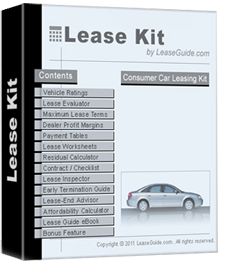
Thousands of people, including myself, have taken advantage of this kit to find the best lease from each manufacturer.
It will help you plan, negotiate, and, if you are currently in a lease, show you if you got a great deal or reveal dealer mistakes.